Part 2 of the Strong & Fit For Life series
If you had to pick one thing – one single training habit – that would do the most to protect your health, your independence and your quality of life over the next thirty years, the research has a clear answer.
It isn’t cardio.
It isn’t yoga.
It isn’t walking more.
It’s lifting heavy weights. Progressively. Consistently. Over time.
This isn’t a gym junkie take. It’s what the science says — and the science has been unusually consistent about it.
What “heavy” Actually Means
Before anything else, let’s be clear about what we mean by heavy – because this word trips women up more than almost any other in fitness.
Heavy doesn’t mean dangerous. It doesn’t mean competitive powerlifting or heaving barbells overhead with bad form. It doesn’t mean your face goes red and you hold your breath and hope for the best.
Heavy is different for every individual and it fully depends on where you are at, now.
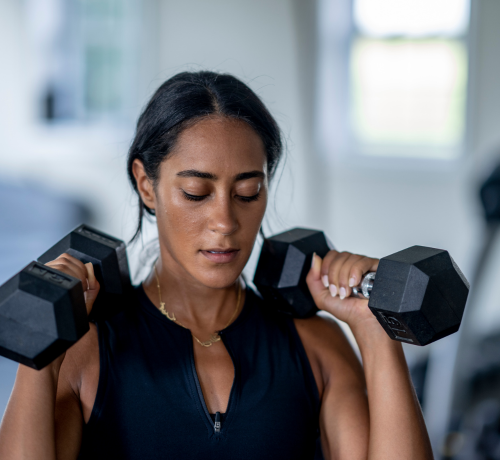
What defines heavy? A load that genuinely challenges your muscles to adapt. In research terms, it typically means working at 70–85% of your one-rep maximum — the point where the last few reps of a set are actually difficult, where you have to focus, where your body is required to work.
Light weights feel comfortable. They feel like you’re doing something. But the physiological signal they send to your muscles and your bones is fundamentally different – and significantly weaker – than what heavy progressive training delivers.
This distinction matters enormously. And it’s one most women have never been told.
What Happens In Your Body From Your Mid-30s Onwards
Here’s the context that makes everything else make sense.
From around 35, and accelerating significantly through perimenopause and beyond, women experience a process called sarcopenia – the gradual, age-related loss of muscle mass. Research shows women can lose 3–8% of their muscle mass per decade without intervention. By the time you reach your 60s, that quiet, invisible loss has compounded into something that affects everything: your metabolism, your energy, your posture, your strength, your ability to move freely and independently.
At the same time, bone mineral density begins to decline – a process directly accelerated by the drop in oestrogen during the menopause transition. Osteoporosis affects approximately one in three women over the age of fifty. And most of them had no idea it was coming.
These aren’t dramatic events. They’re slow, accumulating changes that happen in the background of your life – until the day they aren’t in the background anymore.
The single most effective intervention for both? Progressive strength training with heavy loads.
What The Research Actually Says
Dr Gabrielle Lyon – physician and founder of the muscle-centric medicine movement – describes skeletal muscle as “the organ of longevity.” Her position, backed by a substantial body of research, is that muscle mass is the primary driver of metabolic health, hormonal balance, immune function and long-term independence. Building and maintaining it is not optional for women who want to age well. It is the foundation of everything else.
The research on strength training specifically supports this emphatically:
On muscle mass: Progressive resistance training of at least 10–12 weeks is an effective method for building lean mass and strength in both early and late postmenopausal women. This isn’t limited to young women or women who are already fit – the research holds across fitness levels and ages.
On bone density: Hypertrophy-based strength training, specifically 3 sets of 8–12 repetitions at challenging loads, has been shown to increase bone mineral density at the lumbar spine, total hip, femoral neck and greater trochanter in early postmenopausal women (Maddalozzo et al., 2007). These are precisely the sites most vulnerable to osteoporotic fracture.
On hormones and metabolism: Muscle is metabolically active tissue. More of it means a higher resting metabolic rate, better insulin sensitivity, improved glucose regulation, and a more resilient hormonal environment. Strength training also has a direct positive effect on mood – research consistently shows reductions in symptoms of depression and anxiety following resistance training programs.
On the intensity question: Dr Stacy Sims (exercise physiologist and leading researcher in female-specific training) is emphatic on this point: women need to lift heavy enough to challenge the central nervous system and drive genuine structural adaptation. The hormonal response that builds muscle and protects bone requires a threshold stimulus. Light weights and high reps, however consistently performed, do not cross that threshold.
Why Most Women Have Been Told The Opposite
Here’s where the research history becomes relevant – and a little uncomfortable.
For decades, the dominant message to women about strength training was: go lighter, use more reps, tone rather than bulk, don’t lift too heavy or you’ll get too muscular.
This advice wasn’t malicious. But it was wrong – and it had real consequences.
It was wrong partly because of the research gap we mentioned in Blog 1: the studies underpinning early exercise science recommendations were conducted predominantly on men. What we knew about training loads, progressive overload and muscular adaptation was largely built on male physiology. When it was applied to women, it was watered down rather than reconsidered.
It was wrong partly because of a fundamental misunderstanding of female hormones. Women do not have the testosterone levels required to build the kind of muscle mass that would make them look “bulky” through normal strength training – even training with genuinely heavy loads. That outcome requires exceptional genetics and, for most women, pharmacological support. For the overwhelming majority, heavy progressive training produces a leaner, more defined, more capable physique – not a larger one.
And it was wrong partly because “light and high rep” felt safer – easier to teach, easier to sell, less intimidating, more ‘feminine’ aka appropriate for the ladies.
But safe does not always mean effective, and this is where the industry went so wrong…
What Changes When You Lift Heavy
When you apply progressive, challenging loads to your training – consistently, over time – here’s what actually happens:
- Muscle fibres are recruited and stimulated to grow. The neuromuscular system adapts, motor units are trained to fire together, and muscle protein synthesis is upregulated.
- Bone responds to mechanical loading. The compressive forces placed on bone during heavy lifting send direct signals to bone-forming cells (osteoblasts) to maintain and build density. This is a stimulus that walking and most bodyweight exercise cannot adequately replicate.
- Your metabolism shifts. More muscle mass means your body burns more energy at rest. It also means better blood sugar regulation, improved insulin sensitivity, and more efficient fat metabolism.
- Your hormonal environment improves. Strength training has a direct positive effect on growth hormone and IGF-1 — anabolic hormones that support tissue repair, recovery and body composition. It also helps regulate cortisol over time.
- Your brain adapts. The neuromuscular coordination required for complex loaded movements — squats, deadlifts, carries — creates new neural pathways and supports cognitive function. Research links regular resistance training to reduced risk of cognitive decline.
- You become harder to break. Stronger muscles, denser bones, better balance and more robust connective tissue collectively reduce injury risk — in training, in everyday life, and in the falls and accidents that become increasingly consequential with age.
None of this happens from light weights at comfortable intensities. The stimulus has to be sufficient. And sufficient, for women who want to protect their health for life, means the weights should feel heavy.
Heavy Training Requires Good Coaching – And That’s Not What Every Woman Gets
Here’s the part that most conversations about heavy lifting leave out.
Heavy loads work because they place significant demand on the body. But significant demand on the body requires something in return: movement that is functional, efficient and well-coached. Because a heavy load through a poor movement pattern doesn’t build strength – it builds injury.
This is where too many women have been let down.
We hear versions of this story regularly. A woman joins a gym or signs up with a personal trainer, excited to finally start lifting properly. And then she’s handed a program designed to make her exhausted rather than strong. She’s pushed through movements her body isn’t ready for, at loads she hasn’t been prepared for, with coaching that prioritises intensity over quality. And she gets hurt. Or she can’t walk for three days. Or she quietly decides that heavy lifting just isn’t for her.
It is for her. The problem wasn’t the training. It was the approach.
Heavy, progressive strength training, done properly, should never thrash you. It should challenge you. It should make the last few reps genuinely hard. It should leave you feeling worked, not wrecked. And it absolutely should not leave you injured.
The difference comes down to coaching that understands:
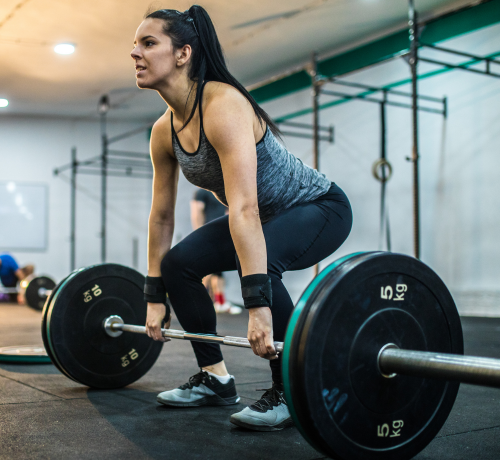
- Movement quality first. Before load is added, the pattern needs to be right. A squat needs depth, control and alignment. A deadlift needs a strong hinge, a neutral spine and proper bracing. These aren’t minor details – they’re what makes the load productive rather than destructive.
- Progressive load, not arbitrary load. What’s heavy for one woman at one point in her training is completely different from what’s heavy for another – or for the same woman six months later. A good coach builds load intelligently, over time, based on what the individual in front of them can actually move well.
- Women’s physiology specifically. Recovery timelines, hormonal fluctuations across the cycle and through perimenopause, connective tissue considerations, pelvic floor awareness – these aren’t edge cases. They’re the everyday reality of training women’s bodies well. A coach who understands this programs differently, cues differently, and adjusts differently than one who doesn’t.
This is not a small thing. The wrong coaching – even with the best intentions – can make heavy lifting feel unsafe, painful and unsustainable. The right coaching makes it the most empowering physical practice of your life.
What This Looks Like At Strong Women Can
Every STRONG session is built around progressive, compound strength training – squats, deadlifts, pressing, pulling, carrying. The loads are intentional. The progressions are planned across weeks and months, not just from session to session.
We don’t randomly vary what you’re doing every week so things stay “fresh.” We build. We load. We track. We progress. Because that’s what the research says actually drives adaptation.
The coaching is specific – not just “lift that” but why that movement, how that range of motion, what you’re working to develop. Because women who understand the why don’t just turn up more consistently – they train with better intent, and they get better results.
And critically: we’ve built the loads around what women’s bodies actually need, not what feels comfortable, not what looks impressive on social media, and not what was designed for a 25-year-old male athlete.
It’s Not Too Late To Start – But The Earlier You Start, The Easier The Road
If you haven’t been lifting heavy – or haven’t been lifting at all – the most important thing to know is this: the research is unambiguous that it is never too late to begin.
Studies show significant improvements in muscle mass, strength and bone density in women in their 60s, 70s and even beyond who begin progressive resistance training. The body’s capacity to adapt to a sufficient training stimulus doesn’t disappear with age – it just requires a little more patience and a lot more intention.
But here’s the other side of that coin – and it matters.
The earlier you start, the easier the road. Not because older women can’t make meaningful progress (they absolutely can), but because the women who begin building strength in their 40s arrive at their 60s with more muscle, denser bones, better movement patterns, and a more resilient body to work from. They’ve stayed ahead of the losses rather than having to claw back from them. They’ve built a foundation that makes everything else – energy, independence, confidence, physical capability – easier to maintain.
Every decade you invest in strength training is a decade your future self will thank you for. And conversely, every decade you delay is a compounding gap that takes more work to close.
If you’re in your 40s or 50s and reading this: this is your window. Not theoretically. Right now. The research on this is unambiguous – the women who train through perimenopause and menopause, rather than waiting until after, protect far more of their bone density, muscle mass and metabolic health than those who pause and restart.
If you’re already in your 60s or beyond: it is still absolutely worth starting. The adaptations are real. The research supports it. Your body is more capable of responding than you’ve probably been told.
What starting doesn’t require is a prior history of lifting. Or a particular starting weight. Or confidence that you know what you’re doing before you walk through the door.
It requires showing up, applying load progressively, and being coached by people who understand what they’re doing and why.
That’s what we’re here for.
If you’ve got questions, send them to support@strongwomencan.com or come visit us at our Women’s Training studio in Highett, Bayside – we’re always happy to help.
Strong Women Can
‘Where Women Build Strength For Life’